The schedule for the 2026 Nagoya Asian Games is set, and experienced sports fans suggest everyone go over the key events in advance to make watching the games more enjoyable.
As a longtime sports fan who’s followed three Asian Games, let me be honest with you—the schedule for the gold medal events at the Nagoya Asian Games is actually quite interesting this time around. The Games open on September 19, with competition officially kicking off on the 20th and continuing through October 4. A total of 469 gold medals will be awarded across 15 “gold medal days.”There are two key dates worth circling: 48 gold medals will be awarded on September 24 alone, and 51 on October 2. Combined, these two days alone account for nearly 100 gold medals—more than the total from the first three days following the opening ceremony. On the closing day, there will be only two equestrian gold medals, bringing the Games to a clean and crisp conclusion.
The schedules for each event are gradually taking shape. Swimming will take place from September 20 to 25, diving from September 26 to 30, and table tennis will run from the day after the opening ceremony through September 28.The men’s and women’s team competitions between China and Japan are scheduled for September 24—which happens to be the first “gold medal peak day.” The mixed doubles lineup has already been finalized, and the upcoming singles and doubles events are sure to be thrilling. Gymnastics runs from September 21 to 25, overlapping with the first half of the swimming competition. On days when events clash like this, you’ll have to decide in advance which ones to watch.
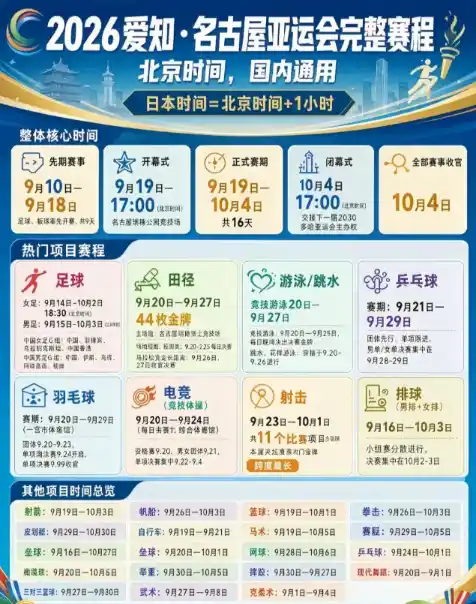
For viewers in China, there’s no time difference when watching the Nagoya Games, which makes it much more convenient than watching the Paris Games. However, since outdoor events are subject to weather changes and the schedule may be adjusted at any time, I recommend marking the finals you’re interested in ahead of time and preparing one or two backup plans.In the first few editions, I didn’t do my homework beforehand and ended up wasting a lot of time hopping between live streams, only to find that all the finals I wanted to watch were scheduled at the same time. Going over the schedule in advance not only ensures you’ll catch the events you want to see but also gives you a rough idea of the teams’ strengths and the overall competitive landscape, so you’ll have a better sense of what’s going on while watching.
The Asian Games feature an extensive schedule, with events spanning multiple core sports such as swimming, diving, table tennis, and gymnastics. The distribution of gold medals and the competition schedule directly affect the pace of the games. Doing your research in advance and making the most of your time will significantly enhance your viewing experience.